<Back to news
10 Aug 2026
School Bag Instead of Cartwheels?
Why familiar movement can be valuable when starting school
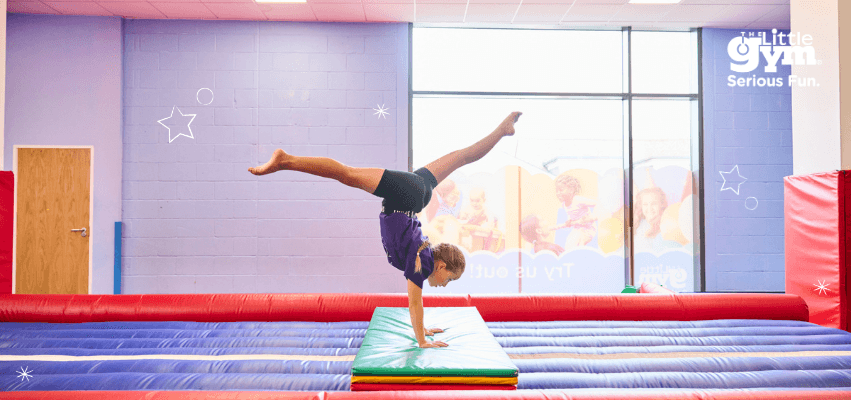
Starting school brings a lot of changes for children and their families all at once. New rooms, new teachers, new routines and new expectations suddenly become part of everyday life. Even children who are excited about school have a lot of new impressions to process during those first few weeks.
It can therefore be tempting to keep the schedule a little emptier at first. At the same time, a familiar activity does not automatically mean additional stress. A regular gymnastics class can offer something familiar during this period and provide a welcome balance to the new school routine.
Familiar routines can provide orientation
Reliable relationships and recurring routines can help children find their footing during times of change. The Center on the Developing Child at Harvard University describes stability and routines as important parts of a supportive developmental environment.[1]
This might be a familiar bedtime routine, time together as a family or a weekly gymnastics class. In a class a child already knows, the space, instructors and routines are familiar. At the same time, movement offers a contrast to the school day: jumping, rolling, climbing and simply using the whole body.
At The Little Gym Köln, we offer dedicated classes for grade school children aged 6 to 12. Especially during the first weeks of school, a familiar movement class can remain something children know and enjoy while so much around them is changing.
Tired does not always mean less movement
Many children are tired after school. Some need quiet time, while others find it easier to relax after they have had a chance to move.
The World Health Organization recommends that children and adolescents aged 5 to 17 get an average of at least 60 minutes of moderate-to-vigorous physical activity per day. This can include active play, sports and active travel.[2]
Of course, that does not mean a tired child should be pushed to exercise. What matters is how they experience the activity: Do they look forward to their class? Do they seem happy afterwards, or regularly overwhelmed?
Body and mind are active together
Balancing, climbing and jumping help children practise balance, coordination, strength and spatial awareness. At the same time, many movement activities also require attention and planning.
A systematic review found a positive association between motor competence and executive functions such as working memory, impulse control and cognitive flexibility. However, this does not prove a direct cause-and-effect relationship.[3]
An obstacle course is a good example of how the two come together: a child remembers the sequence, plans the next step and finds a new solution when something does not work straight away.
Trying things without performance pressure
Once children start school, they often receive more feedback on how they are performing. In gymnastics, however, something does not always have to work on the first try.
A child can try again, accept help or find a different approach. They experience that learning takes time and that another attempt is simply part of the process. In a group, they also practise waiting, watching others and dealing with frustration or excitement.
Does every activity need to continue?
No. Some children genuinely need fewer scheduled activities when they start school. What matters is how the child experiences them.
Parents can ask themselves:
- Does my child look forward to the class?
- Do they seem happy afterwards or regularly exhausted?
- Is there still enough time for free play and sleep?
- Does the class feel enjoyable or more like another obligation?
Sometimes a small adjustment is enough, such as keeping the rest of the afternoon around the class intentionally calm.
How The Little Gym supports children when they start school
In our grade school classes at The Little Gym Köln, activities are adapted to the children’s age and stage of development. Familiar routines provide orientation, while new movement challenges give children plenty of opportunities to try things out.
The class is not meant to feel like another lesson after school. Children can move, explore new challenges and find their own solutions.
Especially during a time filled with new impressions, a familiar gymnastics class can offer a welcome balance to the school day.
Keeping the familiar while making room for the new
Starting school does not automatically mean that familiar activities need to be put on hold. What matters is finding a good balance between school, rest, free play and the things a child enjoys.
Perhaps that weekly gymnastics class is not simply another appointment right now, but a familiar part of an exciting new phase.
If you would like to experience how The Little Gym supports children in an age-appropriate way, you can book an Intro Class at The Little Gym Köln.
Sources
1. Center on the Developing Child at Harvard University, 2026
From Resources to Routines: The Importance of Stability in the Developmental Environment
2. World Health Organization, 2020
3. Ludyga et al., Sports Medicine, 2024