<Back to news
2 Oct 2026
Learning Starts Long Before the Classroom
What PISA Shows About Curiosity, Perseverance and Learning
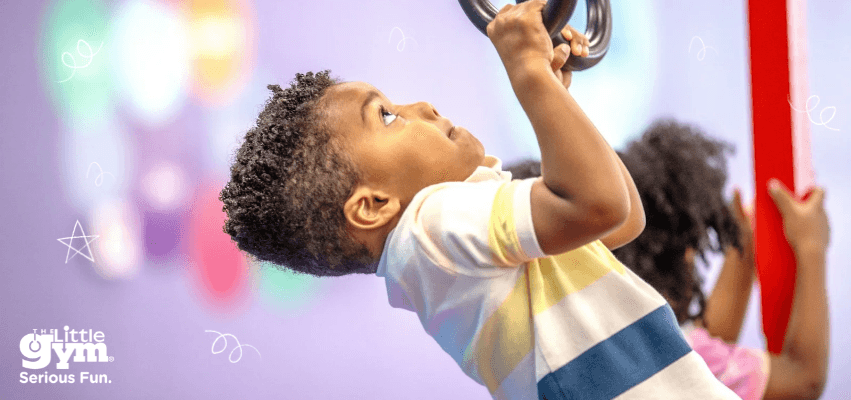
What do children do when something doesn’t work straight away?
That question comes through surprisingly clearly in the results of the latest PISA study. Alongside performance in mathematics, reading and science, the OECD also looks at how young people learn, how curious they are and how they deal with challenges.
At The Little Gym Köln, this is the part we find especially interesting. Because learning through movement begins long before homework and schoolbooks. Trying things out, planning, staying focused, solving problems and starting again after something doesn’t work the first time are all things children experience through gymnastics too.
What PISA shows about curiosity and perseverance
77 percent of the 15-year-olds surveyed in Germany say they are curious about many different things. 64 percent say they make a special effort when a task is difficult. At the same time, this share has fallen by 7.9 percentage points since the previous PISA assessment.[1]
A so-called growth mindset also plays a role: 76 percent of young people in Germany believe that abilities can develop through work, effort and feedback. When it comes to independent learning, however, there is still room for improvement. Only around one third say they frequently or very frequently plan how they want to approach their learning.[1]
PISA assesses 15-year-olds. Its results therefore do not predict how a kindergarten child will learn later on. But they do draw attention to an important question: When and where do children actually develop curiosity, independence and the ability to keep going?
Education begins long before school starts
Public discussion around PISA often focuses on schools, curricula and teaching. But one term is appearing more and more often too: early childhood education.
Learning does not begin on the first day of school. Even very young children discover quantities, colours, shapes, language, rhythm and connections. They learn to listen, remember things, understand rules, try out solutions and work together with other children on shared tasks.
That is exactly where our concept at The Little Gym begins.
In our parent-child classes for children under three, we combine movement with early learning concepts such as colours, quantities, language and rhythm in an age-appropriate way. For kindergarten and preschool children, stories, words, letters and numbers increasingly become part of the class content.
The aim is explicitly not to bring school forward. It is about preparing children for learning by helping them stay curious, listen, understand tasks, find solutions independently and build confidence in their own abilities.
When movement becomes a thinking task
A child at The Little Gym is standing in front of a new obstacle course. They listen, look at the task and remember several different stations.
While balancing, climbing or jumping, they need to control their body, stay focused and make decisions. If something doesn’t work straight away, they try again. Perhaps they need to use a different foot, create a little more momentum or first accept some help from an instructor.
A movement task therefore challenges more than just the body. It can also engage concentration, working memory, self-regulation and problem-solving.
In research, some of these skills are grouped under the term executive functions. These include working memory, inhibitory control and cognitive flexibility. Research reviews suggest that physical activity can support these abilities, particularly when movement also requires attention, decision-making and responding to changing situations.[2][3]
Of course, this does not mean that taking a gymnastics class automatically leads to better school grades. Learning and child development are far more complex than that.
“One more try” is part of the process
At The Little Gym Köln, children regularly experience situations in which something does not work on the first attempt.
They observe, try a different solution or accept help. Sometimes taking a break or choosing an easier variation is part of the process too.
What matters is the experience: Not being able to do something yet does not mean it has to stay that way.
That is exactly why PISA’s focus on perseverance and growth mindset is so interesting to us. Not because PISA shows that gymnastics causes these qualities. But because movement gives children very concrete opportunities to experience what it means to try, adjust and try again.
More than children’s gymnastics
At first glance, The Little Gym Köln is often seen as a children’s gymnastics programme. Movement really is at the heart of our classes, but our educational concept goes beyond that.
We see movement as a way for children to learn physically, cognitively and socially. They move, listen, communicate, remember, solve tasks, experience success and learn how to deal with small setbacks.
For us, school readiness therefore does not begin only in the final year before starting school. The foundations are built much earlier.
Our goal is not to turn four-year-olds into schoolchildren. Our goal is to give children skills and experiences that can make the later transition into school-based learning easier.
Because learning does not only happen at a desk.
Sometimes a child is standing on a beam, looking at the next challenge and thinking:
I’ll try again.
Sources
2. Liu et al., Frontiers in Psychology, 2026
3. Mao et al., Frontiers in Psychology, 2024