<Back to news
23 Oct 2026
Rest, Play, Move: Finding the Right Holiday Balance
Why active time still matters during the autumn holidays
Finally, the holidays are here. No alarm clock, no homework and maybe even a little extra time in pyjamas in the morning. For many families, the autumn holidays are a welcome break from the usual routine.
At the same time, the rhythm of the day changes. School or kindergarten are on pause, mealtimes may shift, and there is not always a clear plan for the day first thing in the morning.
And that is exactly how holidays are allowed to feel.
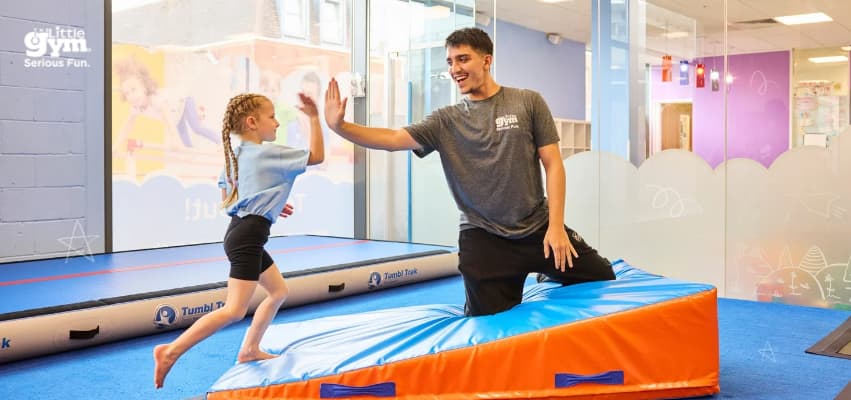
Still, it can be helpful for children when a few familiar elements remain alongside all that free time. Movement can be an enjoyable part of the day, whether that means being outside in the autumn leaves, spending time at the playground or joining a familiar class at The Little Gym Köln.
When everyday routines pause, everyday movement does too
It is often only when the usual routine disappears that we notice how much children normally move throughout the day.
Walking to school or kindergarten, outdoor breaks, taking the stairs, PE lessons and playing with other children all create many small opportunities for movement. During the holidays, some of these naturally disappear.
Research into school holidays looks at exactly this effect. A systematic review of longer summer holidays found that children tended to spend more time sitting and, in some cases, were less physically active. Structured holiday programmes were able to increase physical activity and reduce sedentary time. The programmes included in the review varied considerably, so the findings cannot simply be applied to every holiday week. They do, however, show how much children’s normal daily routine can influence their activity levels.[1]
For the autumn holidays, this does not mean suddenly creating a sports schedule. It simply means keeping movement in mind.
How much movement do children actually need?
Recommendations vary depending on age.
For children between one and four years old, the World Health Organization recommends at least 180 minutes of different types of physical activity spread throughout the day. For three- and four-year-olds, at least one hour of this should be more energetic activity. For children and young people between five and seventeen, the WHO recommends an average of at least 60 minutes of moderate to vigorous physical activity per day.[2]
And organised sport is only one part of that. Running around, climbing, walking, cycling, active journeys and free play all count too.
Physical activity supports muscles, bones, cardiovascular health and overall physical fitness. Especially for younger children, movement is also an important way to explore their own body and the world around them.[2]
Holidays need both movement and rest
More movement does not have to mean more appointments.
Children also need quiet time, sleep, free play and moments without a plan during the holidays. An active morning and a relaxed afternoon are not opposites. A good holiday day can easily include both.
Familiar routines can help too. The Center on the Developing Child at Harvard University describes predictable routines and stability as important parts of a supportive environment for children. At the same time, new experiences and variety are also part of learning. The aim is therefore not to make every day look the same, but to find a good balance between what feels familiar and what feels new.[3]
That might be breakfast together, the usual bedtime routine or a familiar gymnastics class in the middle of an otherwise spontaneous holiday week.
When body and mind work together
Climbing, balancing, jumping or rolling involve more than movement alone.
Children listen to a task, remember a sequence, judge distances and decide what to do next. If something does not work as expected, they need to react and perhaps try a different solution.
Alongside physical skills such as balance, coordination, strength and spatial awareness, attention, working memory, inhibitory control and flexible thinking can also come into play.
Research reviews on so-called executive functions suggest that physical activity can have a positive effect on these processes in children. Activities appear particularly interesting when children also need to stay attentive, make decisions and respond to changing situations.[4]
Of course, this does not mean that every gymnastics class automatically improves concentration or school performance. It simply helps explain why varied movement can engage both body and mind at the same time.
Movement can be simple
An active holiday day does not need much planning.
A walk can turn into collecting autumn leaves. A fallen tree trunk can become something to balance on. Puddles can be jumped over, the playground offers plenty of opportunities to climb and run, and at home a few cushions can quickly become a small obstacle course.
Not every activity needs a goal. Children can experiment, take breaks and come up with their own ideas.
Especially during the holidays, movement can simply be something that feels good and is fun.
Familiar classes and additional Camp Days
At The Little Gym Köln, our regular classes continue throughout the autumn holidays.
For children, a familiar class can be a nice anchor in the week. They know the space, our instructors and the general routine, while still discovering new exercises and movement challenges.
We also offer Camp Days during the autumn holidays. Children can spend an active holiday day with movement, shared activities and a variety of challenges.
For families where parents are working during the school holidays, these days can also provide practical support when organising childcare.
That way, movement can remain part of the holidays without the whole week becoming over-scheduled.
Holiday mode on, movement stays
The autumn holidays can be slower, more spontaneous and more relaxed than everyday life.
But because the school run, outdoor breaks and many other daily opportunities for movement disappear, it is still worth giving children plenty of chances to stay active.
Sometimes that might be a walk through the autumn leaves, an afternoon at the playground, a gymnastics class or a Camp Day at The Little Gym Köln.
The goal is not to fill the holidays with plans. It is about finding a good balance between movement, rest, free time and a few familiar moments.
We are looking forward to active autumn holidays with you.
Sources
1. Eglitis et al., International Journal of Behavioral Nutrition and Physical Activity, 2024
Health effects of children’s summer holiday programs: a systematic review and meta-analysis
2. World Health Organization
Physical activity recommendations for children and adolescents
3. Center on the Developing Child at Harvard University, 2026
From Resources to Routines: The Importance of Stability in the Developmental Environment
4. Mao et al., Frontiers in Psychology, 2024